Asthma and Anaphylaxis Training for QLD Schools and Education & Care Settings: What Staff Need, How Response Plans Work, and How Training Standardises the Response
Why Asthma and Anaphylaxis Deserve Specific Focus in School Training
Most first aid training covers asthma and anaphylaxis within the broader unit scope. In school and education and care settings, the complexity is layered:
- Individual health management plans: students may have specific documented plans that override generic first aid steps. Staff need to know where these plans are kept and how to action them alongside first aid response.
- Epinephrine / EpiPen use: in QLD, administration of adrenaline auto-injectors in emergency situations is permitted for lay first aiders - but the technique and escalation steps need practised confidence, not hesitation.
- Child-specific presentations: asthma and anaphylaxis present differently in young children than in adults. Response must match the patient, not just the textbook.
- Multiple children in the same environment: management of the emergency while maintaining supervision of other children is a real operational challenge.
Book first aid training (including asthma and anaphylaxis response) for your Gold Coast or Brisbane school: Request an onsite quote from SKLD Training
ASCIA Guidelines: Asthma First Aid in Schools
The Australasian Society of Clinical Immunology and Allergy (ASCIA) provides the standard used in most QLD schools for anaphylaxis management. Key ASCIA guidance for first responders in schools:
- Act quickly - anaphylaxis is a medical emergency. Severe allergic reactions can be life-threatening within minutes.
- Give adrenaline auto-injector (EpiPen or equivalent) as first line treatment if prescribed, before any other medication.
- Call 000 immediately after giving adrenaline.
- Lay the person flat - do not allow them to stand or walk.
- If no improvement after 5 minutes and a second adrenaline injector is available, give a second dose.
- Antihistamines do NOT treat anaphylaxis - they are not a substitute for adrenaline.
(ASCIA Anaphylaxis e-training and guidelines)
Asthma Response in Schools: The 4×4×4 Protocol
For moderate asthma (staff uncertain if severe), the standard QLD/national asthma first aid protocol from the National Asthma Council:
- Sit the person upright (not lying down)
- Give 4 puffs of reliever (blue/grey) inhaler - one at a time, via spacer if available
- Ask the person to take 4 breaths from the spacer after each puff
- Wait 4 minutes - if no improvement, repeat
- If still no improvement after 2 rounds - call 000
(National Asthma Council Australia: First Aid for Asthma)
How These Scenarios Are Covered in HLTAID011 and HLTAID012
| Scenario type | HLTAID011 Provide First Aid coverage | HLTAID012 (education and care) additional focus |
|---|---|---|
| Moderate asthma attack | Recognition, spacer/inhaler technique, 4×4×4 protocol, escalation to 000 | Child-specific presentations; action plan integration; supervision during response |
| Anaphylaxis (severe allergic reaction) | Recognition, calling 000, laying flat, general first aid positioning | Auto-injector use (EpiPen), ASCIA action plan steps, notify family, 000 immediately |
| Mild allergic reaction | Recognition of mild vs severe, observation, escalation criteria | Monitoring shift from mild to severe, plan activation criteria |
| Infant/toddler asthma | Not primary focus | Child-modified technique; recognising distress signs in non-verbal children |
ASCIA Anaphylaxis e-Training: What Schools Also Use
ASCIA offers online anaphylaxis e-training specifically designed for school and childcare staff. It is separate from HLTAID011/012 and provides deeper content on:
- How to read and implement an individual ASCIA action plan
- Auto-injector technique specific to brands used in QLD
- Common triggers and early recognition
- Building a whole-school anaphylaxis management approach
Many QLD schools require both: HLTAID012 or HLTAID011 for first aid competency and ASCIA e-training for anaphylaxis-specific protocol depth.
(ASCIA Anaphylaxis e-Training)
Gold Coast and Brisbane School Zones
Demand for asthma and anaphylaxis-specific first aid training in schools correlates with school population size and the number of students with documented management plans:
- Gold Coast (Palm Beach, Robina, Southport, Helensvale, Coomera): primary and high school clusters with moderate to high prevalence of asthma and allergy action plans. Onsite HLTAID012 with scenario focus on anaphylaxis and asthma.
- Brisbane (Chermside, North Lakes, Runcorn, Indooroopilly, Kelvin Grove): large primary school clusters; diverse populations with higher prevalence of both conditions.
Training That Actually Builds Response Confidence
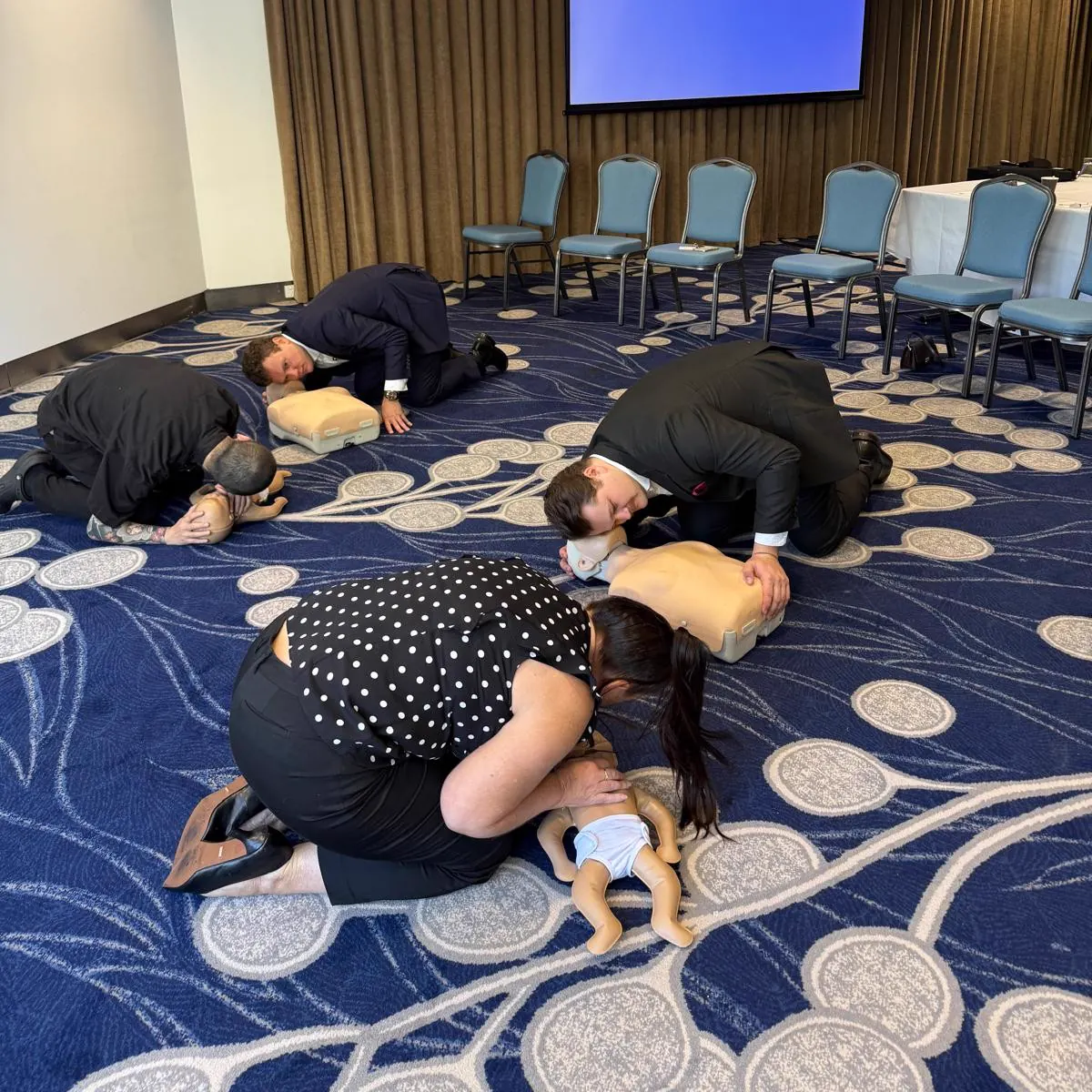
The common failure mode in school asthma/anaphylaxis training: staff can describe the steps, but haven't physically practiced them. When a student actually goes into anaphylaxis, the steps feel different under adrenalin.
Effective training for this scenario requires:
- EpiPen trainer practice: using the demonstration auto-injector (blue top) on a training pad - feeling the mechanism, verifying technique.
- Plan retrieval drill: locating the student's action plan from the known location (sick bay, first aid kit, teacher folder) without delay.
- Role split: who manages the student, who calls 000, who retrieves the EpiPen, who manages the rest of the class?
- Scenario end-point: what does handover to emergency services look like? What do you tell the 000 operator?
Compliance Line (Required)
Training and assessment delivered on behalf of Allens Training Pty Ltd RTO 90909.
FAQ
What first aid training covers asthma and anaphylaxis in QLD schools?
Both HLTAID011 Provide First Aid and HLTAID012 Provide First Aid in an education and care setting include asthma and anaphylaxis response. HLTAID012 has broader child-specific and education and care context. ASCIA e-training is typically also recommended for schools with students who have formal anaphylaxis action plans.
Do teachers need ASCIA training in addition to first aid?
In QLD, many schools require ASCIA anaphylaxis e-training for staff who interact with students with documented anaphylaxis action plans. This is separate from HLTAID011/012 and provides specific protocol training aligned to individual plans. (ASCIA)
Can you give an EpiPen to a child in QLD who isn't your patient?
In Queensland, lay first aiders are generally permitted to administer an adrenaline auto-injector in an emergency. Always follow the individual student's action plan and call 000. Confirm current QLD-specific guidance with your school administration.
What is the asthma first aid protocol for schools?
The standard is the 4×4×4 protocol: 4 puffs of reliever, 4 breaths each, wait 4 minutes, repeat if needed - then 000. Follow the student's individual management plan if one exists. (National Asthma Council)
Where can I book school first aid training near me on the Gold Coast?
Enquire via SKLD Training for onsite HLTAID011/012 sessions including asthma and anaphylaxis scenarios - Gold Coast and Brisbane schools.
Sources (Official)
Related Articles
Anaphylaxis Training for QLD Schools and Childcare: EpiPen Technique, ASCIA Guidelines, and How Onsite Training Builds Real Confidence on the Gold Coast & Brisbane
Anaphylaxis training searches spike when a school or childcare service enrols a student with a documented allergy action plan - or worse, when staff realise they've never actually used an EpiPen trainer. This guide explains what anaphylaxis training covers for QLD schools and childcare, how ASCIA guidelines shape the response, how HLTAID011 and HLTAID012 address it, and why onsite scenario training is the only approach that builds genuine response confidence.
Read more →HLTAID011 vs HLTAID012 vs HLTAID009: Which First Aid Course Do You Need in QLD? (Workplaces, Schools, Childcare, NDIS)
People search 'HLTAID011 vs HLTAID012' because they don't want to book the wrong course. This guide explains the difference in plain English, maps each unit to the roles that need it - workplaces, schools, childcare, NDIS - and gives a clear decision table for Gold Coast and Brisbane teams.
Read more →First Aid Training for Childcare and OSHC in QLD: HLTAID012 Requirements, Annual CPR, and Onsite Delivery for Gold Coast and Brisbane Services
Childcare and OSHC operators search for first aid training that meets regulated service requirements - which means HLTAID012, not just a standard first aid course. This guide explains what HLTAID012 Provide First Aid in an education and care setting covers, how it differs from HLTAID011, how annual CPR works alongside it, and how onsite delivery runs for Gold Coast and Brisbane childcare services.
Read more →Ready to Book Your Training
SKLD Training delivers nationally recognised first aid courses directly to your Gold Coast workplace.
View Available Dates