Choking First Aid for Adults, Children & Infants: What to Do, When to Act, and How Gold Coast & Brisbane Workplaces Build Confidence
Why Choking Response Needs Confident Practical Training
Choking is predictable - it happens most often during mealtimes, in childcare settings, in hospitality, and in aged care. It's also one of the most anxiety-inducing first aid events because:
- The casualty is often conscious and distressed but cannot communicate clearly
- Time pressure is intense - complete airway obstruction can cause unconsciousness in under 60 seconds
- The physical techniques (back blows, abdominal thrusts) require confident force - tentative delivery won't clear an obstruction
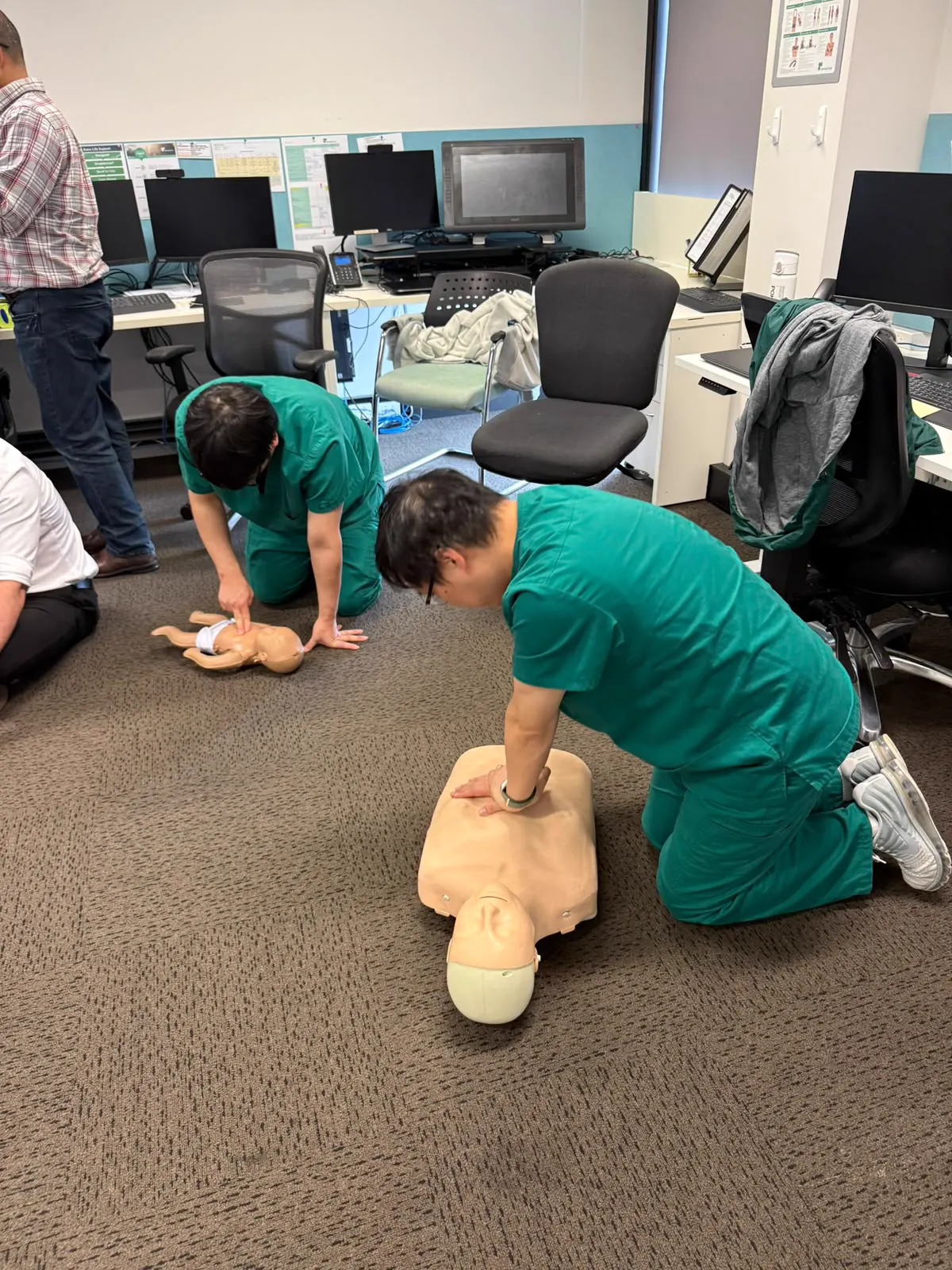
- Infants require entirely different technique - and most people have never practised on a baby manikin
Generic awareness is insufficient. People who've practised the techniques - multiple repetitions on manikins - respond faster and with greater force and accuracy than those who've only seen it demonstrated.
Book first aid training (includes choking response for adults, children, infants): Request a quote via SKLD Training
First: Partial vs Complete Obstruction
The first decision in choking is: is the airway partially or completely blocked?
| Partial obstruction | Complete obstruction | |
|---|---|---|
| Signs | Coughing, gagging, some noise present, breathing (however laboured) | Cannot speak, cannot cough effectively, no airway noise, turning blue/grey, hand to throat |
| Action | Encourage coughing - do NOT begin back blows or abdominal thrusts yet. Stay with the person, monitor for escalation to complete obstruction | Act immediately - begin the back blows and abdominal thrusts sequence |
Coughing is protective. If the person is coughing effectively, the airway is not fully blocked - let them cough. If they stop coughing and can't clear the object, act immediately.
Adult Choking Response (Step by Step)
For adults and children over 1 year - this follows the approach aligned with ARC/ANZCOR guidance:
- Recognise complete obstruction: cannot speak, cough effectively, or breathe. Cyanosis (blueing around lips) may be present.
- Tell the person you are going to help them.
- Give 5 back blows: lean the person forward, support their chest with one hand. Strike firmly between the shoulder blades with the heel of the other hand, 5 times. Each blow is a separate, sharp strike - not a rub.
- Check if obstruction is cleared after each blow: if object is visible in the mouth, remove carefully. If cleared - stop. If not -
- Give 5 abdominal thrusts (Heimlich): stand behind the person, arms around the waist. Form a fist and place above the navel and below the sternum. Pull sharply inward and upward, 5 times.
- Alternate 5 back blows and 5 abdominal thrusts until cleared or person becomes unconscious.
- If unconscious: call 000 immediately, lower the person to the floor, start CPR. Each time you open the airway to give breaths - look for the object before attempting ventilation.
Child Choking Response (1 Year to Puberty)
The technique is the same as for adults - back blows and abdominal thrusts - but scaled for the child's size:
- Back blows: child leaning forward - 5 firm strikes between shoulder blades.
- Abdominal thrusts: gentler force proportional to the child's size; same positioning as adult.
- Kneel or crouch to be at the child's level if possible.
- Never perform blind finger sweeps in the mouth - only remove a visible object.
Infant Choking Response (Under 1 Year)
Infant technique is significantly different and must be practised on infant manikins:
- Face-down position: support the infant face-down along your forearm, head lower than chest. Support the head with your hand.
- Give 5 back blows: with the heel of your free hand, deliver 5 firm strikes between the shoulder blades.
- Turn face-up: support the head and turn the infant face-up along your forearm.
- Give 5 chest thrusts: use two fingers on the centre of the chest, one finger-width below the nipple line. Give 5 downward chest thrusts (not abdominal - infants have vulnerable abdominal organs).
- Alternate back blows and chest thrusts until cleared or infant becomes unresponsive.
- If unresponsive: start infant CPR and call 000.
Where Choking Response Sits in First Aid Training
| Unit | Choking coverage | Notes |
|---|---|---|
| HLTAID011 Provide First Aid | Adult and child choking technique | Standard workplace first aid unit; covers adult through puberty |
| HLTAID012 Provide First Aid in an education and care setting | Adult, child, and infant choking technique | Essential for childcare and OSHC - includes infant manikin practice |
| HLTAID009 Provide cardiopulmonary resuscitation | Includes recognition and response to unconscious choking casualty (CPR link) | CPR-only unit; choking covered at the point where the casualty is unconscious |
Industry Settings Where Choking Response Matters Most
| Setting | Gold Coast / Brisbane examples | Why choking readiness matters |
|---|---|---|
| Childcare and OSHC | Robina, Coomera, North Lakes, Runcorn | Infants and toddlers are highest risk - mealtime supervision with trained staff is essential |
| Hospitality (restaurants, cafes) | Surfers Paradise, Broadbeach, South Bank | Customer choking events during service; staff must be able to act without hesitation |
| Gyms and fitness studios | Southport, Robina, Surfers | Post-workout snacking, supplement drinks - less common but real risk |
| Aged care | Burleigh, Southport, Chermside | Swallowing difficulties common in aged care; highest choking risk population |
| NDIS day programs | Gold Coast and Brisbane metro | Participants may have swallowing conditions (dysphagia); mealtime support requires trained staff |
Compliance Line (Required)
Training and assessment delivered on behalf of Allens Training Pty Ltd RTO 90909.
FAQ
What do you do if someone is choking?
If the person cannot speak, cough effectively, or breathe - immediate action needed. Lean them forward and give 5 firm back blows between the shoulder blades. Then 5 abdominal thrusts (Heimlich). Alternate until cleared or they become unconscious. If unconscious - CPR and call 000.
What if a baby is choking?
Infant technique: face-down on your forearm (head lower than chest), 5 back blows between shoulder blades; flip face-up, 5 chest thrusts with two fingers. Alternate until cleared. If unresponsive - infant CPR and call 000. Do NOT use abdominal thrusts on infants.
When should you call 000 for a choking emergency?
If the obstruction doesn't clear within the first return of back blows and abdominal thrusts, or if the person becomes unconscious - call 000 immediately. Continue CPR if the person is unconscious and not breathing. If you're alone: do 2 minutes of choking response first, then call 000.
Is choking covered in standard first aid training?
Yes - adult and child choking is covered in HLTAID011 Provide First Aid. HLTAID012 adds infant choking technique with manikin practice. HLTAID009 (CPR-only) covers unconscious choking.
Where can I book first aid training near me on the Gold Coast that includes choking?
Enquire via SKLD Training for HLTAID011 and HLTAID012 sessions covering choking, CPR, and the full first aid spectrum - Gold Coast and Brisbane onsite delivery available.
Sources (Official)
Related Articles
First Aid Training for Childcare and OSHC in QLD: HLTAID012 Requirements, Annual CPR, and Onsite Delivery for Gold Coast and Brisbane Services
Childcare and OSHC operators search for first aid training that meets regulated service requirements - which means HLTAID012, not just a standard first aid course. This guide explains what HLTAID012 Provide First Aid in an education and care setting covers, how it differs from HLTAID011, how annual CPR works alongside it, and how onsite delivery runs for Gold Coast and Brisbane childcare services.
Read more →Onsite First Aid Training on the Gold Coast & Brisbane: The Group Booking Guide (How It Works, Room Setup, Roster Planning)
Businesses searching 'onsite first aid training' want logistics, not brochures: how group sessions run, what space is required, how to minimise disruption, and what evidence looks like when training is done. This guide covers the full process for Gold Coast and Brisbane teams - from enquiry to completed certificates.
Read more →HLTAID011 vs HLTAID012 vs HLTAID009: Which First Aid Course Do You Need in QLD? (Workplaces, Schools, Childcare, NDIS)
People search 'HLTAID011 vs HLTAID012' because they don't want to book the wrong course. This guide explains the difference in plain English, maps each unit to the roles that need it - workplaces, schools, childcare, NDIS - and gives a clear decision table for Gold Coast and Brisbane teams.
Read more →Ready to Book Your Training
SKLD Training delivers nationally recognised first aid courses directly to your Gold Coast workplace.
View Available Dates